

The Problem Isn’t Too Big. Your Map Is Too Small.
Why good work keeps getting undone, and what it takes to make it stick.
A senior innovation leader said something to me recently that has stayed with me. We were talking about the gap between designing for a user and designing for an ecosystem. He said, essentially: solving for individual user needs is hard enough. Solving for a community is exponentially harder. Solving for an entire ecosystem? That feels impossible.
The kind of problem he was describing has a name: wicked. Not difficult. Not complicated. Wicked, meaning it lives inside a human ecosystem where causes are distributed, actors have competing incentives, and no single person is in control. These problems don’t yield to project management. They don’t yield to better strategy. They yield to understanding.
He wasn’t wrong to feel that way. But I think he was misreading the situation.
The problem isn’t the size of the challenge. The problem is the map he was using to navigate it.
Most of the leaders I work with are smart, experienced, and genuinely committed. Many of them are doing good work that keeps getting undone. The pilot succeeded, but the funding didn’t continue. The initiative landed, but then leadership changed. The program worked, and then it was cut. This isn’t a story about failure. It’s a story about good work that doesn’t stick. And more awareness, more data, more sophisticated frameworks haven’t changed that.
What’s missing isn’t understanding. Most of these leaders can see the system acting against them, and a lot of them are standing up to it with real courage. What they haven’t yet seen is that they have agency to shift it. That’s a different thing entirely.
So when someone tells me solving for an ecosystem is too big, what I hear is: they haven’t yet had the chance to see it. Because when you can see the system, the problem stops feeling impossible. It starts feeling navigable.
Three things shift when you approach a wicked problem ecosystemically.
You stop trying to control what you can’t control. Most wicked problems involve actors who are outside your authority. You cannot solve for them. You can, however, understand how they move through the system, what they need, what they block, and where their energy goes. That understanding changes what actions are available to you.
You start working across all layers of the problem, not just the visible ones. Wicked problems operate at multiple orders of complexity simultaneously: transactional, functional, strategic, and ecosystemic. The mistake is sometimes ignoring a layer entirely, fixating on the ones that feel most tractable, and almost always treating them as separate. Navigational intelligence means working across all four simultaneously, staying attuned to what’s moving and why, and being ready to adapt when the system responds. It also means tracking different things: not just outputs and milestones, but outcomes, emerging patterns, signs that the system is shifting. That’s what makes the work compound rather than stall.
You let go of the idea that there is a finish line. Ecosystems are not fixed. They shift, adapt, and respond. The aim isn’t resolution. It’s a healthier direction of travel. A system with fewer blockages, stronger flows, and more capacity to adapt. That requires ongoing navigation, not a one-time intervention.
None of this makes the work easier. It does make it more honest. And it turns out that honest is a lot more useful than impossible.
The leaders who engage this way are not the ones with the biggest budgets or the most authority. They are the ones willing to see the full system they are operating inside, including the parts they don’t control, including the dynamics they didn’t create, including the history that is still shaping the present. They are stewards, not architects.
The ecosystem was always there. You just didn’t have a way to see it.
That’s what changes.
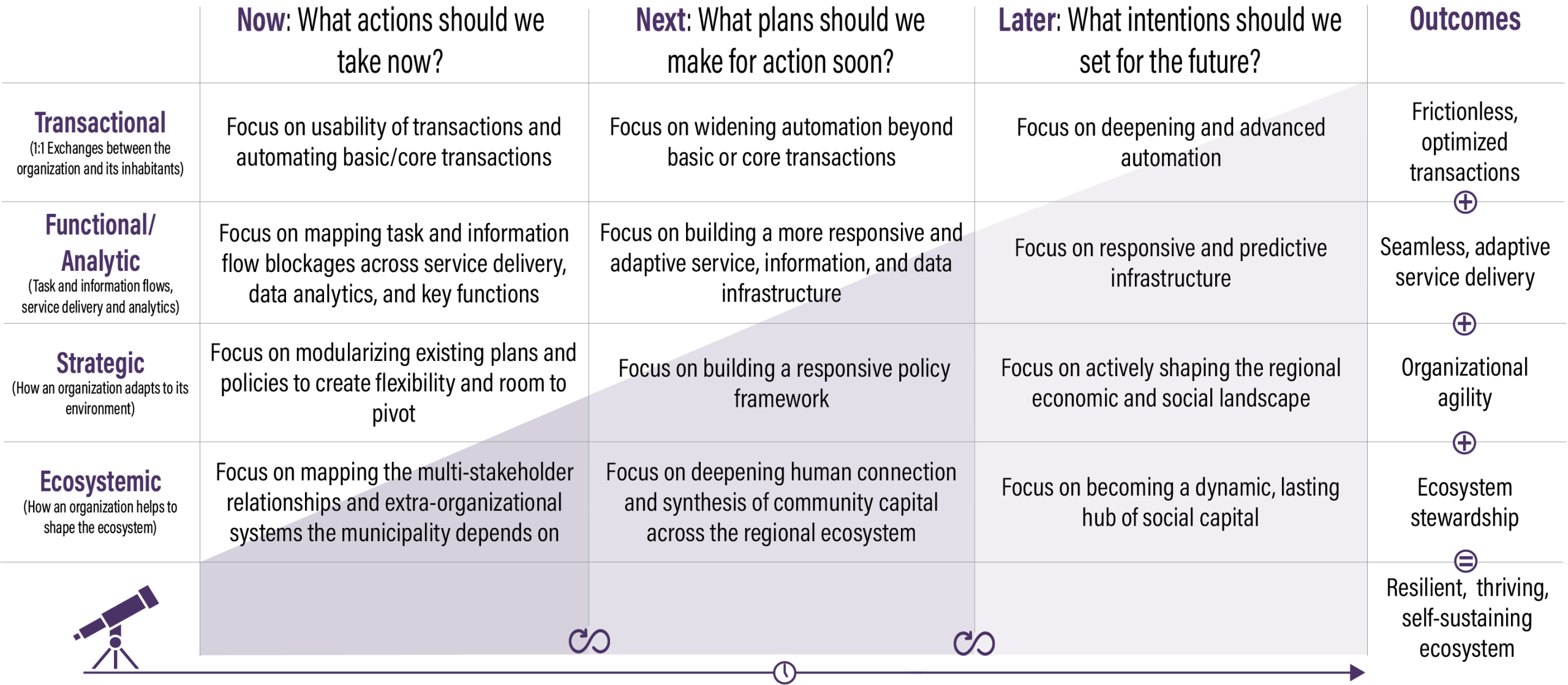
Working across all four orders of complexity simultaneously, with attention to how movement at one layer shifts the others, is what makes the work compound rather than stall.
What would become possible if you could see the human ecosystem your platform is operating inside?
The most useful conversations I have start with a leader who has a sound platform and a nagging sense that something larger is missing. If that’s you, I’d like to hear what you’re navigating. Use the form to start a conversation.
Want to see your own map? Take our 5-minute Diagnostic and find out which orders of complexity your organization is navigating well — and which ones are still invisible to you.