NextWAVE Innovation
Clarity in Complexity
NextWAVE Innovation helps leaders and organizations navigate complexity with clarity.
Through systems innovation, strategic planning, and systemic design, we create fit-to-purpose strategies that move organizations and ecosystems forward.
Our flagship initiative, The Ecosystem Project, brings these ideas to life in our book and practice.
What We Do: Helping Leaders Navigate Complex Human Ecosystems
The Ecosystem Project
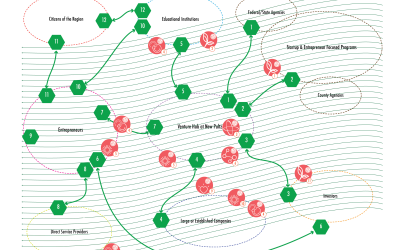
Our flagship consulting practice and book. A practical method for seeing and understanding complex systems and co-creating strategies that lead to real, lasting transformation.
Research & Strategic Planning
We bring a systems lens to research, strategy, and design. Drawing on decades of experience in innovation and UX design, we help leaders uncover insights, frame challenges, and build strategies that are fit-to-purpose in complex, adaptive environments.
Who We Work With: Leaders, Teams, and Organizations Facing Complex Challenges
This work is for people who are facing complexity that won’t respond to simple fixes.
You may find yourself here if you are:
Leaders and decision-makers – who are responsible for outcomes but don’t fully control the system shaping them, and know that conventional strategy, planning, or change tools are no longer enough.
Teams working across boundaries – who are expected to collaborate across organizations, sectors, or mandates- are running into misalignment, stalled progress, or unintended consequences.
Organizations operating in complex human systems – such as public sector agencies, foundations, higher education institutions, and mission-driven organizations, where success depends on many actors, incentives, and constraints working together.
Practitioners and advisors – who sense there is a deeper, systemic issue at play, but lack a shared way to see it, talk about it, or act on it without oversimplifying.
This work is especially useful when:
-
Problems keep recurring despite good intentions and capable people
-
Accountability exists, but authority is distributed
-
Progress requires coordination, learning, and adaptation, not just execution
-
The system itself needs to be understood before solutions can be designed
When This Work Is Not a Fit
This work may not be a good fit if:
You are looking for a quick fix or a predefined solution
Ecosystem illumination is not a plug-and-play framework or a set of best practices. It is a way of seeing and working with complexity that takes time, care, and attention.
You already know what the answer is and want validation
If the primary goal is to confirm an existing plan or decision, this work will likely feel uncomfortable. It is designed to surface what is actually shaping outcomes, not to reinforce preferred narratives.
The challenge is primarily technical or operational
When problems are well-bounded and can be solved through optimization, process improvement, or execution discipline, simpler approaches are often more effective.
There is no appetite for learning or adaptation
This work assumes a willingness to pause, reflect, and adjust as new insights emerge. If learning is seen as a risk rather than a necessity, the conditions are not yet right.
A note on readiness
Many people come to this work not because they want to, but because the system they are in has stopped responding to familiar tools. If you are unsure whether this is the right fit, that uncertainty itself is often a useful starting point.
Why it Matters
Most leaders face challenges that feel overwhelming. Plans stall, pilots fizzle, and problems keep coming back. That’s because complexity doesn’t yield to simple fixes.
Whether you’re leading a transformation, aligning diverse stakeholders, or designing strategy in a shifting environment, the real work begins with clarity.
At NextWAVE, we bring that clarity through systems innovation, research, and strategic planning. We help leaders see the whole system—so they can act with confidence and create meaningful, lasting change.
About Karyn
Meet Karyn Zuidinga
Founder of NextWAVE Innovation and co-creator of The Ecosystem Project.
Karyn is a seasoned practitioner in systemic innovation, research, and strategic planning. With decades of experience in UX design and organizational strategy, she brings both clarity and collaboration to leaders navigating complex challenges.
She also serves as Vice Chair of the Association for Managers of Innovation (AMI), a pioneering nonprofit dedicated to advancing creativity and innovation in organizations and society.

Thought Leadership
Why Your Change Efforts Keep Stalling (And What to Do About It)
Photo by Phil Hearing on UnsplashWhy Your Change Efforts Keep Stalling (And What to Do About It) Everything is moving, but nothing is changing. You’ve got change initiatives, task forces, and dashboards. Everyone is busy. The pace is fast. Yet the real problems—the...
Fractional Design Leadership: a solution to the vicious cycles of product design.
Most software companies struggle to define a business strategy that matches what their customers are really looking for – but it doesn’t have to be that way.
It’s time to change our thinking, and our approach.
We’re thrilled to announce a new family of services designed to help you break through endless design cycles and shift to a culture of data-driven decision making to design products that keep your customers wanting more:
Fractional Design and Innovation Leadership.
Systems: The Sixth Element of User Experience
In the light of the shift that’s taken place since the beginning of UX from designing software-like interactions on the web to building web-based software and services, and seeing the impact these have on the wider world, it’s time to update the elements of User Experience to include a new element: systems.
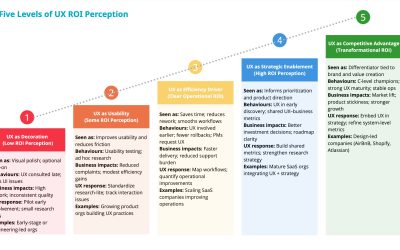
A Systems Thinking Approach to Understanding the Value of UX
Recently, I’ve encountered a wave of skepticism from senior leaders in product development circles. They’re posing some tough questions: Why invest more in UX? What’s the value of UX? Can’t product managers handle research? Why can’t product managers do the research? Yet, amidst these “anti-UX” questions I’m seeing and experiencing a completely different on-the-ground reality: product teams champion UX. They see both the tactical and strategic value of a solid UX practice. In this article, I’ll dive into why that gap exists, how to bridge it and how to respond to the “anti-UX” questions in a meaningful way using a systems-based approach. If you’re navigating the challenges of trying to deliver a complex product or argue for the value of UX, let’s connect to explore the power of a systems-based approach in driving product success.