
Case Study
Reframing Product Value Through Systems-Aware UXIntro
Using the Four Orders of Complexity to expand how a team understands the value of UX — and the product itself.
In partnership with a product and design team, we facilitated an ROI of UX workshop that used the Four Orders of Complexity to move the conversation beyond usability and features toward strategic, systemic, and ecosystemic value. The result was not just clearer metrics, but a reframed narrative about the product’s impact — and the broader system it participates in.
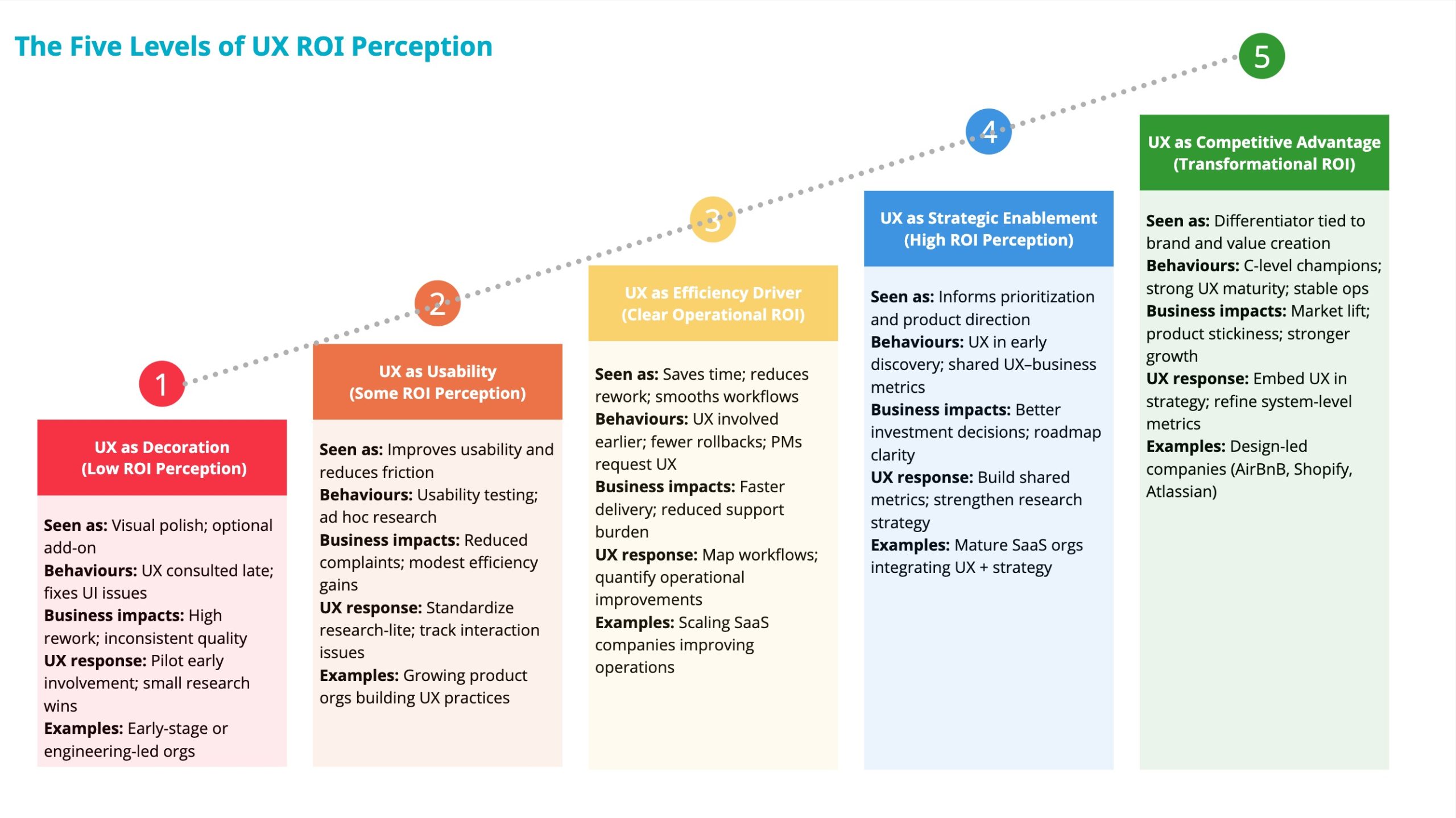
Download the five levels of UX ROI Perception
Details
Reframing Product Value Through Systems-Aware UX
Context
The team wanted to articulate the return on investment of UX work.
Like many organizations, the initial framing centred on:
-
Efficiency
-
Conversion
-
Reduced friction
-
Improved customer satisfaction
Important — but incomplete.
The deeper question became:
What is the real value of this product within the larger system it influences?
Approach: The Four Orders of Complexity
We structured the workshop around the Four Orders of Complexity as a thinking scaffold:
-
Transactional
Improvements in tasks, flows, and usability. -
Functional / Analytical
Performance metrics, conversion, retention, and measurable gains. -
Strategic
Brand positioning, competitive differentiation, product-market alignment. -
Ecosystemic
System-level impacts, stakeholder dynamics, network effects, and long-term structural change.
Rather than debating ROI in the abstract, participants mapped UX contributions across all four orders — revealing how design choices influence not just users, but partners, institutions, and the broader operating environment.
Key Shifts
1. From Cost Justification to Value Creation
The conversation moved from defending UX spend to articulating how UX shapes product trajectory and systemic positioning.
2. From Feature Thinking to Impact Thinking
The team began identifying second- and third-order effects of their work — including how their product changes behaviours, relationships, and incentives across the ecosystem.
3. From Internal Metrics to External Consequences
They surfaced ecosystem-level impacts their product has on customers, partners, and adjacent stakeholders — expanding how success is defined.
4. Narrative Reframing
Armed with this expanded lens, the team began redefining the stories they tell about what they do — internally and externally — aligning product development with strategic intent.
In Practice
This workshop demonstrated that ROI conversations become more powerful when:
-
UX is positioned as a system-shaping discipline, not just an interface function.
-
Metrics are connected to long-term strategic and ecosystemic outcomes.
-
Teams are invited into structured reflection that moves beyond immediate deliverables.
The result was a highly engaging, participatory session that produced both clarity and momentum — not just numbers, but insight.